Amwell End, Hertfordshire
Project Overview
- Client: Sandhill Homes
- Architect: Argento
- Project type: Commercial
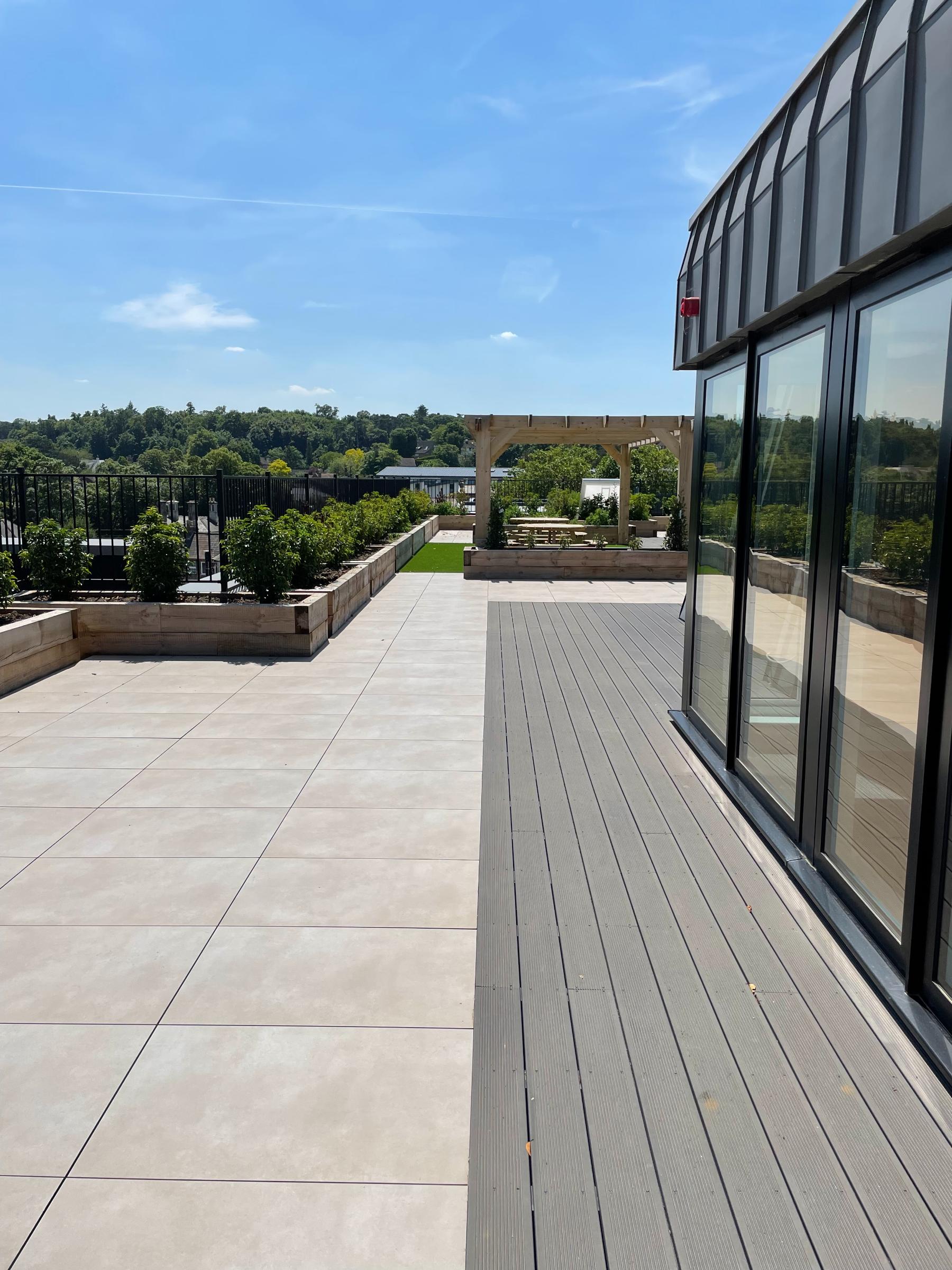
- Size: 5-storey building comprising seven commercial units at ground floor and 32 residential units, with car parking to the rear adjacent to the River Lea
- Location: Amwell End, Ware, Hertfordshire
- Our role: dbstructural were recommended by the architect and directly appointed by the client to provide structural and civil engineering design.
Project requirements and design process
This project involved the design of a 4-storey reinforced concrete frame building with a first-floor transfer deck above the retail units. The fifth floor was an additional timber frame structure.
Key structural elements
- Reinforced concrete frame: The main structural system consisted of a reinforced concrete (RC) frame. The frame was designed to accommodate a mix of commercial and residential functions, requiring careful planning of load paths.
- Suspended ground floor slab: A 300mm thick reinforced concrete ground floor slab was adopted to provide a solid foundation for the building and minimise differential settlement. This slab was suspended to allow for effective integration with the underlying pile foundation system.
- Transfer slab: A crucial component of the design was the 450mm thick reinforced concrete transfer slab at the first-floor level. By taking the load from columns that sit above the slab and transferring it to supporting columns underneath using a transfer slab this meant we could avoid using the provision of transfer beams.
- Upper floor slabs: The upper floors were constructed using 250mm thick reinforced concrete flat slabs with localised thickenings at areas where columns transferred heavy loads.
- Achieving column-free spacing: The columns were placed on a regular grid down to the transfer deck. At the ground floor, a more open layout was achieved by spacing the columns at approximately 5.5m x 5.5m intervals, allowing for unobstructed retail areas. Party walls were utilised to conceal structural elements where possible.
- Lateral stability: To ensure overall stability, two reinforced concrete cores were strategically positioned at either end of the building.
- Service penetration: Service penetration is an aperture, opening, or gap that can be open or closed, made through a fire-resisting element in a building to allow for the passage of services. All service penetration were coordinated alongside the architect.
Robust multi-discipline approach
We worked closely with several third-party suppliers to integrate key structural elements into the overall design:
- Ancon: Cantilever balconies in both steel and concrete RC main frame required thermal breaks. Additional reinforcement requirements were then incorporated into our concrete detailing drawings.
- Wincrow: Due to masonry height constraints, a horizontal movement joint was needed, requiring masonry support angles fixed to the first-floor slab.
- Max Frank: Shear rails were used to mitigate punching shear concerns within the transfer deck.
- Concrete frame contractor: The main contractor opted for Stairmaster formwork, and we provided reinforced concrete detailing for this element.
All reinforced concrete detailing was carried out in-house, ensuring a fully coordinated design.
Complex foundations and piling challenges
The site presented several challenges due to:
- Existing obstructions from the piles of a previous building
- Poor ground conditions
- Proximity to the river
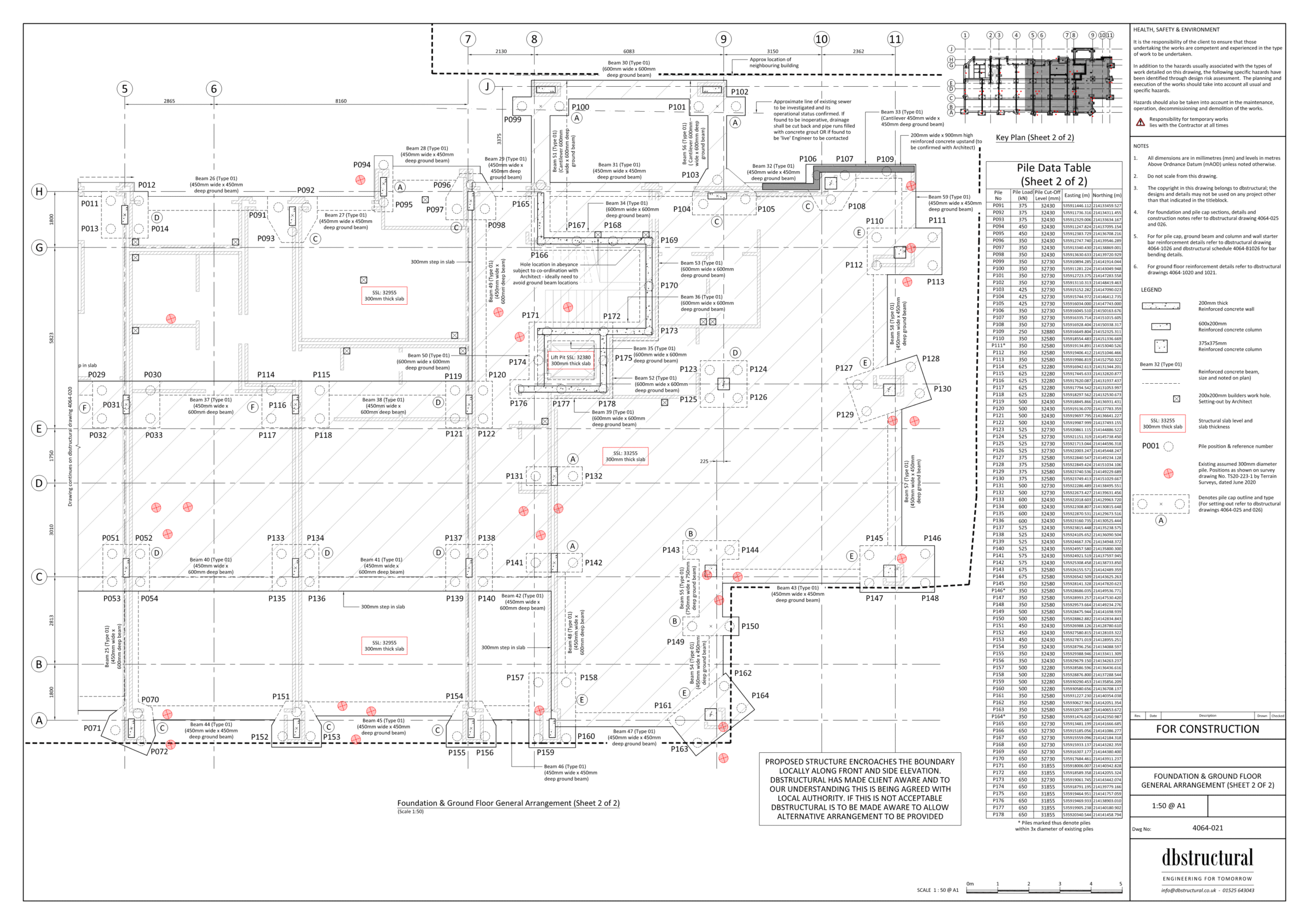
As a result, piled foundations were required. However, unexpected obstructions from previous structures caused complications. A post-demolition survey was conducted due to the frequency of encountering obstacles, allowing us to design pile caps efficiently without delaying progress on site.
Cantilever ground beams and party wall considerations
With the building located tight against a neighbouring property, we utilised a series of cantilevering ground beams with set-back piles. This approach allowed for a structurally sound foundation while mitigating potential issues related to the party wall.
Drainage design
- Foul water drainage: An indirect connection was made to the existing Thames Water sewer within the site footprint.
- Surface water drainage: Water was directed to the rear of the property and collected, including car park run-off. Due to level constraints, a pump system was installed to move water up to an existing Thames Water manhole at a controlled rate of 5l/s before it discharged via gravity at the current outflow into the river.
Conclusion
This project highlighted the importance of creative problem-solving in structural engineering, particularly when dealing with complex ground conditions and tight site constraints. By implementing efficient pile cap solutions for sand and cantilever ground beams, we were able to deliver a robust and cost-effective structure without delaying site progress.
– Take a closer look –